Shifting From Late-Stage Diagnosis to Lifelong Brain Health
More than half of dementia cases in Singapore go undiagnosed. The window for prevention is wide open — if we can reach people in time.
The challenge
The National University Health System (NUHS) is one of Singapore's largest integrated health systems, serving communities across the western region and beyond. Within its geriatric and neurology teams, clinicians have long grappled with a troubling reality: an estimated 51.5% of dementia cases in Singapore remain undetected, even as research suggests that nearly half of all cases are preventable through early lifestyle intervention.
The challenge is not simply one of awareness. Memory loss is widely perceived as a normal part of ageing, making it easy to miss early signs. Relevant patient information is often scattered across clinical encounters. And for older adults living alone or in smaller family units, the informal observations that might prompt a conversation with a doctor are less likely to surface. By the time a diagnosis is made, the most valuable window for prevention has often passed.
The solution
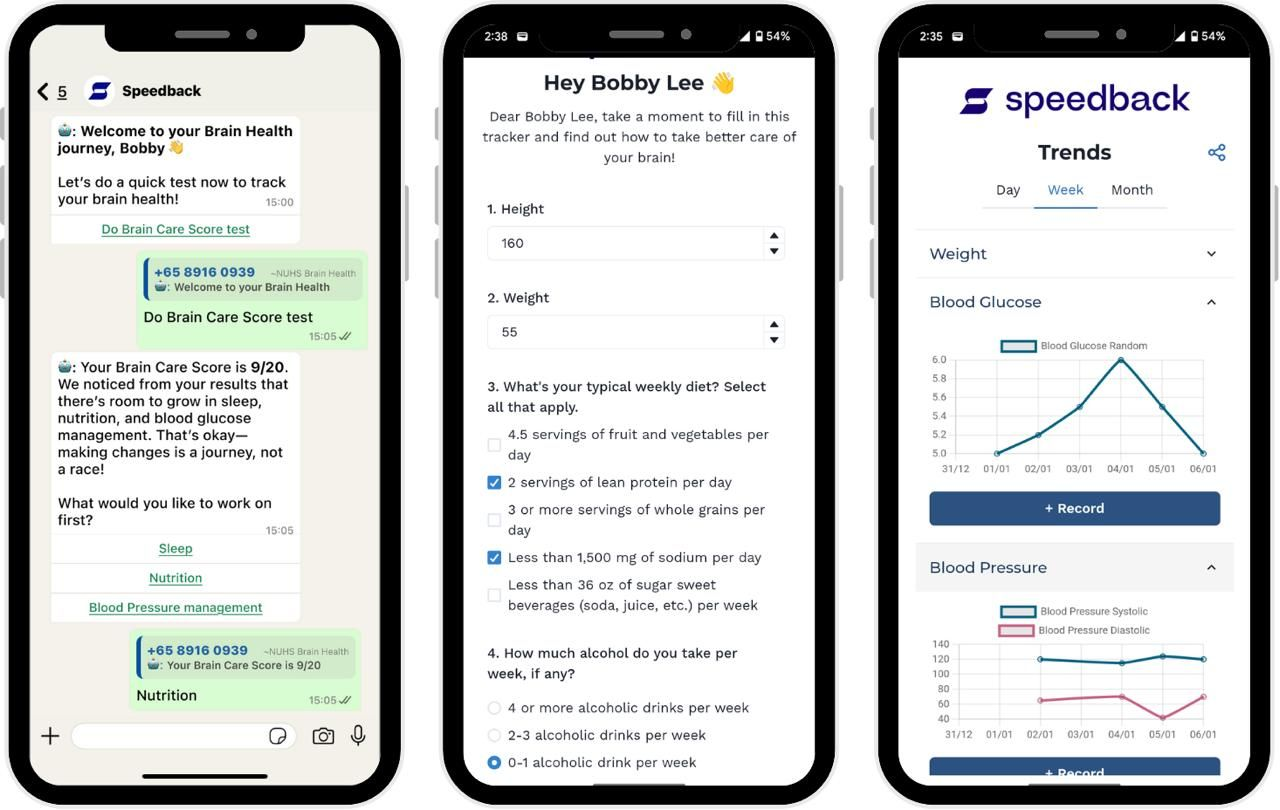
Equitech partnered with NUHS to co-develop and power the Brain Care Tool — a culturally tailored, AI-enabled platform designed to shift the focus from late-stage diagnosis to lifelong brain health. At its heart are two complementary innovations: the Brain Care Score, a holistic measure tracking 12 modifiable risk factors across physical, lifestyle, and social-emotional domains; and the Brain Care Coach, an AI-powered coaching tool built on the Speedback platform that delivers personalised nudges and supports users in adopting brain-protective behaviours.
The design process was shaped as much by community as by clinical expertise. Focus group discussions with residents spanning diverse ages, backgrounds, and digital literacy levels informed how the tool was built — ensuring it speaks to the people it is designed to serve, in ways that feel relevant and accessible to them. Behaviour change frameworks grounded in evidence guided the coaching architecture, with social-psychological strategies embedded throughout to sustain motivation over time.
The results
The Brain Care Tool represents a meaningful shift in how brain health can be supported at scale — moving from episodic, clinic-based encounters toward continuous, personalised engagement that reaches people in their everyday lives. The ambition is a future where individuals can actively track and improve their brain health before symptoms emerge, supported by an AI coach that adapts to their needs and a clinical team that can identify and reach those most at risk.
With community partners already engaged across Singapore and infrastructure designed for replication across healthcare providers, the model is built to travel — offering a practical, scalable template for proactive brain care well beyond its initial deployment.